
Flooring replacement costs $3 to $22 per square foot installed in 2026, including materials and labor. Budget flooring like laminate and vinyl runs $3 to $7 per square foot. Mid-range options like engineered hardwood and LVP run $6 to $12. Solid hardwood and tile run $8 to $22 or more. For a 1,500 square foot home, the total flooring cost typically runs $4,500 to $15,000.
Key Takeaways
- Flooring replacement costs $3 to $22 per square foot installed, with most whole-home projects running $4,500 to $15,000.
- LVP (luxury vinyl plank) is the most popular choice in 2026 for its durability, waterproofing, and cost at $4 to $8 per square foot installed.
- Solid hardwood is the most expensive option at $9 to $22 per square foot but adds the most resale value.
- Labor is $1.50 to $8 per square foot depending on material and subfloor prep needed.
- Removing existing flooring adds $0.50 to $2 per square foot for tear-out and disposal.
- Subfloor repair and leveling is the most common hidden cost and can add $1 to $4 per square foot.
Table of Contents
- Average Cost by Flooring Material
- Cost by Room and Square Footage
- Labor and Installation Costs
- Hidden Costs: Subfloor and Tear-Out
- How to Choose the Right Flooring
- Where You Can Save
- Frequently Asked Questions
- Final Word
Average Cost by Flooring Material
The flooring replacement cost, also called floor replacement cost or replace flooring cost, varies more by material choice than any other factor. Cost data from Angi, HomeAdvisor, and the NAHB all confirm this wide range. Here is a comparison of the most popular flooring options in 2026, including both material and installation cost per square foot:
| Flooring Type | Material Cost | Install Cost | Total per Sq Ft | Lifespan |
| Vinyl sheet | $0.50 to $2 | $1 to $3 | $1.50 to $5 | 10 to 20 years |
| Laminate | $1 to $5 | $1.50 to $4 | $2.50 to $9 | 15 to 25 years |
| Luxury vinyl plank (LVP) | $2 to $6 | $1.50 to $4 | $3.50 to $10 | 20 to 30 years |
| Ceramic tile | $1 to $8 | $4 to $14 | $5 to $22 | 20 to 30+ years |
| Porcelain tile | $3 to $12 | $4 to $14 | $7 to $26 | 25 to 50+ years |
| Engineered hardwood | $4 to $9 | $3 to $8 | $7 to $17 | 20 to 30 years |
| Solid hardwood | $6 to $15 | $4 to $8 | $10 to $23 | 30 to 100 years |
| Carpet | $1 to $5 | $0.50 to $2 | $1.50 to $7 | 5 to 15 years |
| Polished concrete | $2 to $6 | $3 to $10 | $5 to $16 | 30+ years |
LVP, endorsed by the National Wood Flooring Association as a viable alternative to hardwood, has become the most popular choice for whole-home renovations in 2026 because it is waterproof, durable, easy to install, and available in realistic wood and stone looks at a cost of $4 to $8 per square foot installed. It is the best balance of cost, durability, and appearance for most living areas, kitchens, and bathrooms, and the return on investment on a whole-home LVP installation is among the highest of any flooring material. For the broader renovation context, see our pillar on how much a home renovation costs.
Cost by Room and Square Footage
The total new flooring cost depends on the square footage being covered. Here is how total costs land at different home sizes and material choices:
| Home Area | LVP ($5/sq ft) | Engineered Wood ($10/sq ft) | Solid Hardwood ($15/sq ft) |
| 500 sq ft | $2,500 | $5,000 | $7,500 |
| 1,000 sq ft | $5,000 | $10,000 | $15,000 |
| 1,500 sq ft | $7,500 | $15,000 | $22,500 |
| 2,000 sq ft | $10,000 | $20,000 | $30,000 |
These figures use midrange installation rates and do not include tear-out, subfloor repair, or transitions. Add 10% to 15% waste factor for cuts, especially in rooms with irregular shapes or diagonal lay patterns.
Different rooms also have different needs. Wet areas like kitchens, bathrooms, and mudrooms need waterproof flooring: LVP, tile, or sheet vinyl. Bedrooms and living rooms can use any flooring type. Solid hardwood is not recommended below grade (basements) because moisture expansion can buckle the boards.
Labor and Installation Costs
Labor makes up 30% to 50% of total flooring replacement cost, ranging from $0.50 per square foot for simple carpet installation to $8 or more per square foot for complex tile patterns. Here is what labor costs by material type:
| Flooring Type | Labor Cost per Sq Ft | Notes |
| Vinyl sheet or LVP | $1.50 to $3.50 | Floating installation, fastest |
| Laminate | $1.50 to $3 | Floating, quick |
| Carpet | $0.50 to $2 | Simple and fast, padding required |
| Engineered hardwood | $3 to $8 | Glue down, nail down, or float depending on type |
| Solid hardwood | $4 to $8 | Nail-down required, slower |
| Ceramic/porcelain tile | $4 to $14 | Most labor-intensive, pattern adds cost |
Tile is the most labor-intensive flooring because of the mortar bed, setting, and grouting process. A large-format tile, a diagonal lay pattern, or a mosaic inset adds cost beyond the base rate. Solid hardwood is the second most labor-intensive because it must be nail down installed into the subfloor and finished in place.
A worked budget example for replacing flooring in 1,200 square feet of a 3-bedroom home with LVP throughout:
| Item | Details | Cost |
| LVP material (1,320 sq ft with 10% waste) | $4.50/sq ft | $5,940 |
| Installation labor | $2.50/sq ft | $3,000 |
| Old carpet tear-out | $0.80/sq ft | $960 |
| Transition strips | 8 doorways | $400 |
| Subfloor leveling compound (minor) | 200 sq ft | $500 |
| Subtotal | $10,800 | |
| Contingency (10%) | $1,080 | |
| Total | $11,880 |
This $11,880 project replacing carpet with LVP throughout most of a 1,200 square foot home is well within the typical range for this scope.
Hidden Costs: Subfloor and Tear-Out
Two costs catch homeowners by surprise more than any others in a flooring project:
Subfloor repair and leveling: New flooring requires a flat, solid subfloor. Low spots, squeaks, and damaged areas must be addressed before installation. Leveling compound costs $1 to $3 per square foot for minor work. Replacing damaged subfloor boards costs $2 to $4 per square foot. In older homes, a significant portion of the subfloor may need attention, pushing the total cost well above the flooring cost alone.
Tear-out and disposal: Removing existing flooring costs $0.50 to $2 per square foot depending on material and labor rates in your area. Carpet is fastest to remove, at $0.50 to $1 per square foot. Glued-down flooring like vinyl tile is slowest, at $1 to $3 per square foot. Always get a separate line item for tear-out in your contractor bid. The scope of work in each bid should clearly show whether tear-out and disposal are included or excluded.
These are the category of hidden costs our guide to the hidden costs of hiring a contractor covers in detail. Confirming what each bid includes, and what it excludes, protects your budget. See our guide on how to read a contractor estimate for the line-by-line comparison method.
How to Choose the Right Flooring
The right flooring choice balances budget, durability, and the specific conditions of each room. Here is a decision framework:
Wet areas (kitchen, bath, laundry): Choose waterproof flooring only. LVP and tile are the top choices. LVP is faster and cheaper to install. Tile is more durable and adds more resale value in bathrooms.
Living areas and bedrooms: Any flooring type works. Solid hardwood offers the best resale value and long-term durability. Engineered hardwood offers a similar look at lower cost and is more stable in variable humidity. LVP is the most practical and budget-friendly option.
Basements: Tile or LVP only. Solid hardwood expands with moisture below grade and is not a suitable choice. Sheet vinyl is an option for very low budgets.
High-traffic areas: Tile, LVP, and solid hardwood in that order are the most durable. Laminate can be scuffed by heavy foot traffic and is not waterproof, making it a lower-priority choice for entryways and kitchens.
Consider how flooring choices connect across rooms too. Using the same flooring material throughout creates visual continuity that feels larger and more cohesive. This also reduces waste and cuts, lowering the total installed cost versus mixing materials room to room. See our guides on living room renovation cost and bedroom renovation cost for how flooring fits into per-room renovation budgets.
Where You Can Save
Choose LVP over engineered hardwood: LVP delivers a realistic wood look at half the installed cost and is more waterproof. In most living areas and kitchens, it performs as well or better for daily use.
Buy materials directly: Flooring can be purchased from a home store or online retailer and supplied to the installer. This avoids contractor markup on materials, which can run 15% to 25%. Confirm the installer is comfortable working with owner-supplied material first.
Reduce waste: Order accurately. Use a floor plan to measure each room, add 10% waste for rectangular rooms and 15% for rooms with diagonal lay or multiple angles. Ordering accurately avoids paying for leftover material you do not need.
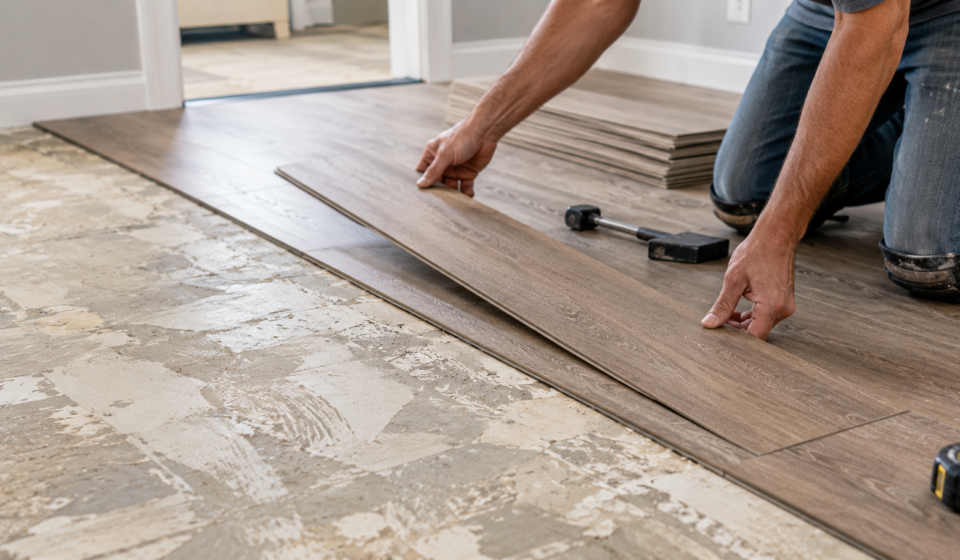
Install over existing flooring where allowed: LVP and laminate can often be installed as a floating floor over existing tile, vinyl, or hardwood if the surface is flat. This saves the tear-out cost of $0.50 to $2 per square foot and reduces labor.
DIY installation: LVP and laminate floating floors are realistic DIY projects for patient homeowners. The main tool required is a miter saw or circular saw for cuts. For a 1,000 square foot area, DIY installation saves $1,500 to $3,500 in labor costs.
Frequently Asked Questions
How much does flooring replacement cost?
Flooring replacement costs $3 to $22 per square foot installed in 2026 depending on material. Budget options like LVP and laminate run $3.50 to $9 per square foot. Mid-range engineered hardwood runs $7 to $17. Solid hardwood runs $10 to $23. Tile runs $5 to $26 depending on the tile grade and installation complexity.
What is the cheapest type of flooring?
Sheet vinyl is the least expensive option at $1.50 to $5 per square foot installed. Carpet and laminate are the next most affordable at $1.50 to $9 per square foot. LVP provides a significant step up in durability and appearance for $3.50 to $10 per square foot. For budget projects where cost is the primary concern, LVP is usually the best value overall.
What flooring adds the most home value?
Solid hardwood consistently adds the most resale value of any flooring type. It is the most desired by buyers and appraisers. Hardwood floors in good condition are noted positively in appraisals and are a key selling feature in most markets. Tile in kitchens and baths is also valued. LVP is increasingly accepted but still considered a step below real hardwood by most buyers.
How long does flooring installation take?
A professional crew can install 500 to 1,000 square feet of LVP or laminate per day. Tile installation is slower at 100 to 200 square feet per day because of the setting and grouting time. A 1,500 square foot whole-home LVP replacement typically takes 2 to 3 days. A whole-home tile floor can take 1 to 2 weeks.
Do I need a permit for flooring replacement?
Generally no, for standard flooring replacement. Permits are typically not required for replacing floor finishes. However, if the project involves subfloor replacement that goes to the structural level, or if you are in a condo with HOA rules about flooring type and underlayment, check those requirements first.
Can I install new flooring over old flooring?
Yes, in some cases. LVP and laminate floating floors can be installed over existing flat, firm tile, vinyl, or hardwood if the surface is in good condition and the height difference at transitions is manageable. This saves tear-out cost. Solid hardwood and most tile must be installed over a bare subfloor. Never install new flooring over soft, spongy, or damaged existing flooring.
Final Word
Flooring replacement costs $3 to $22 per square foot installed in 2026, with most whole-home projects running $4,500 to $15,000 for a standard-sized home. LVP is the most popular and cost-effective choice for most rooms. Solid hardwood adds the most resale value. Tile is the most durable choice for wet areas.Builder-grade carpet is the cheapest short-term option but often costs more per year of useful life than a quality LVP install. Plan for the hidden costs that estimates often omit: subfloor leveling, tear-out and disposal, and transitions between rooms.
Confirm each bid includes these separately so you are comparing complete scope. Consider DIY installation for LVP or laminate in accessible rooms to save $1.50 to $3.50 per square foot in labor. And get three bids before committing, since flooring labor rates vary more between contractors than most homeowners realize. For the full renovation context, see our guides on living room renovation cost, bedroom renovation cost, whole house renovation cost, renovation cost per square foot, and the pillar on how much a home renovation costs. If you are still asking how much does a home renovation cost overall, that pillar breaks it down by room and scope.