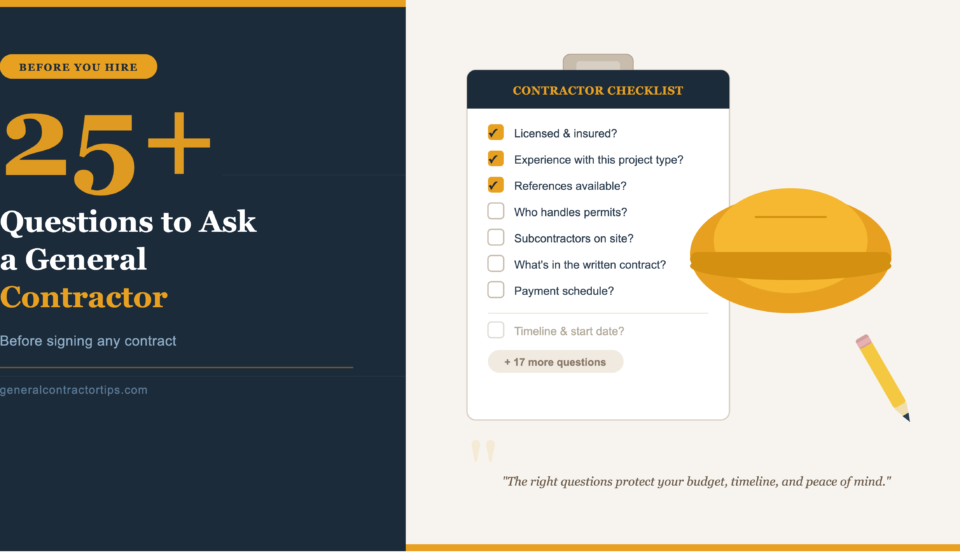

Before hiring a general contractor, ask about their license number, insurance certificates, project timeline, who will be on-site daily, how change orders are handled, what the payment schedule is tied to, and what their workmanship warranty covers. The answers reveal more about a contractor’s reliability than their portfolio or price ever will.
Key Takeaway
- More than 1 in 4 homeowners (28%) who hired a contractor experienced problems. Asking the right questions up front prevents most of them (JW Surety Bonds, 2025)
- 45% of homeowners who experienced contractor issues had to pay $1,000 or more to fix the mistakes (JW Surety Bonds, 2025)
- 41% of homeowners do not read reviews before hiring. Skipping contractor screening questions is equally costly
- A contractor who cannot answer these questions clearly is telling you something. Running a background check through your state licensing board before the meeting costs nothing and often reveals disqualifying history. Listen to what the answers tell you
- Always get answers in writing before signing the contract, not after
Table of Content
- Why These Questions Matter
- Category 1: Licensing, Insurance and Credentials
- Category 2: Experience and Past Work
- Category 3: Project Scope, Team and Timeline
- Category 4: Contracts, Payments and Pricing
- Category 5: Communication and Problem Resolution
- Category 6: Warranty, Cleanup and Closeout
- Bonus Questions Worth Asking
- What Good and Bad Answers Look Like
- Frequently Asked Questions
Introduction
More than half of American homeowners who hired a contractor went over budget on their last renovation project. Nearly half experienced delays. These are not outliers caused by bad luck. They are the predictable result of skipping the contractor screening process and signing contracts without asking the right questions first.
The vetting process most homeowners use is too thin: get a quote, check a few Google reviews, pick the lowest bid. That process does not protect you. The contractor interview is where protection actually happens.
This article gives you 25 questions before hiring a contractor, organized into six categories so you can move through a meeting without forgetting anything. More importantly, it tells you what good answers look like, what bad answers sound like, and what to do when a contractor refuses to answer at all.
This guide is for homeowners in the renovation planning stage who want a reliable contractor checklist and vetting guide they can use in every estimate meeting. Read the complete guide to hiring a general contractor for the broader hiring framework this checklist fits into.
Why These Questions Matter
According to JW Surety Bonds research from 2025, the average contractor mistake cost homeowners $902 to fix and took 21 days to resolve. More than a third of homeowners who experienced contractor issues needed over a month to sort them out. The most common problem was contractors leaving jobs unfinished, reported by 31% of affected homeowners.
None of those outcomes are inevitable. Most stem from a failure of due diligence at the hiring stage.
The contractor interview is your one real opportunity to assess a GC before committing. A licensed, experienced, well-organized contractor welcomes these questions. They have clear, specific answers ready. A contractor who hesitates, gives vague answers, or tries to skip past your questions is showing you exactly how they will communicate when your project hits a problem.
Ask every question. Take notes. If you cannot get satisfactory answers in the meeting, do not sign.
Category 1: Licensing, Insurance and Credentials
These are non-negotiable. Before any other conversation, verify that the contractor is legally allowed to do the work and financially protected to do it safely.
Question 1: Can you provide your contractor license number right now?
A licensed general contractor should be able to give you their license number on the spot. Do not accept “I’ll send it later.” Verify the number yourself through your state licensing board before the meeting ends. The license should be active, not expired, and valid for the type of work you need.
If they hesitate or do not have the number memorized, ask why. Legitimate contractors know their license number the way a driver knows their plate number.
Question 2: Are you licensed in this state specifically?
Contractor license requirements vary by state. Some states require a general contractor license. Others license by trade or project type. A contractor licensed in one state is not automatically licensed in another. If your contractor is based in a neighboring state, this question is essential.
For a full breakdown of how to check contractor license status in every state, see our guide to How to Verify a Contractor’s License and Insurance (State-by-State).
Question 3: Do you carry general liability insurance and workers’ compensation? Can I see the certificate?
Ask for a Certificate of Insurance (COI) before signing anything. The COI should list your name as the certificate holder. Then call the insurance company directly to confirm the policy is current.
Without general liability coverage, you bear the cost of any property damage the contractor causes. Without workers’ compensation (also written as workers compensation), you can be held liable if a worker is injured on your property. This is one of the most serious homeowner protection gaps in residential construction.
Question 4: Are your subcontractors also licensed and insured?
Most general contractors use subcontractors for specialized trades: electrical, plumbing, drywall, tile. Ask whether each subcontractor is individually licensed for their trade and carries their own insurance. Some GCs require this. Others do not.
A contractor who cannot tell you immediately whether their subs are insured is a contractor who has not verified it themselves.
Question 5: Are you bonded? What does your surety bond cover?
A contractor bond (also called a surety bond) provides financial protection if the contractor fails to complete the job, fails to pay subcontractors, or violates building codes. Bonding is not required in every state, but it adds a meaningful layer of homeowner protection.
Ask specifically: what is the bond amount and what events trigger a claim? A bond for $10,000 on a $100,000 project provides limited coverage. Understand what you are actually protected against.
Category 2: Experience and Past Work
License and insurance tell you a contractor is legally qualified. Past work tells you if they are actually good at what they do.
Question 6: How many years have you been doing this type of project specifically?
General contracting experience is not universal. A contractor with 20 years of commercial experience may have limited residential construction background. Ask specifically about experience with your project type: kitchen remodels, home additions, full gut renovations, roofing.
Question 7: Can you show me three recently completed projects similar to mine?
Request completed projects from the last 12 to 18 months. If possible, ask to see them in person. A portfolio of photos is useful but a finished project you can walk through tells you far more about craftsmanship and finish quality.
Question 8: Can you provide three references I can contact directly?
Ask for contact information for at least three clients from projects completed in the past year. Call each reference. Ask specific questions: Did the project finish on time? Did it stay within the original contract price? How did the contractor handle problems when they came up? Would you hire them again?
Our detailed guide on How to Check Contractor References the Right Way includes a complete list of reference call questions that uncover information references do not volunteer.
Question 9: Have you ever had a complaint filed against your license?
Check this yourself through the state licensing board regardless of what they say. Most state databases include disciplinary actions, complaints, and license suspensions. A single past complaint with a clear resolution is different from a pattern of unresolved claims.
Question 10: Have you worked on homes of this age or construction type before?
Older homes built before 1980 often have lead paint, asbestos, outdated electrical systems, and non-standard framing. Contractors unfamiliar with these issues can cause significant problems if they are not equipped to handle them. If your home is older, this question is essential.
Category 3: Project Scope, Team and Timeline
Understanding who will actually be doing the work, when it starts, and how long it runs protects you from two of the most common contractor problems: unexpected delays and scope creep.
Question 11: Who will be on my job site every day? You personally or a crew supervisor?
Many GCs manage multiple projects simultaneously. Find out who will be your primary on-site point of contact. If it is a crew supervisor, meet that person before signing. If the GC plans to show up only occasionally to check in, know that now so your expectations are set correctly.
Question 12: Will you be using subcontractors on this project? Which trades?
Subcontractor management is a core GC responsibility, but the quality of those subs directly affects your project outcome. Ask which trades will be subcontracted. Ask whether these are regular long-term partners or whoever is available. Long-standing subcontractor relationships usually mean better coordination and accountability.
Question 13: What is the estimated project timeline from start to finish?
A professional contractor should be able to give you a phase-by-phase project timeline, not just a start date and an estimated finish. Ask for key milestones: demolition complete, rough-in inspections passed, drywall installed, final walkthrough. A detailed renovation schedule demonstrates genuine project management capability.
A vague answer like “about six to eight weeks” with no breakdown is a warning sign.
Question 14: What is your current workload? When can you start?
A contractor who can start tomorrow may be a contractor with no other work. Good GCs are typically booked 8 to 12 weeks out. Ask about their current job load and whether they have the capacity to give your project the attention it needs. Overstretched contractors are a leading cause of project delays.
Question 15: Who pulls the building permits?
Building permits for structural work, electrical upgrades, plumbing changes, and additions are the contractor’s responsibility in most cases. A legitimate contractor knows which permits are required for your specific project and pulls them without being asked. If a contractor suggests skipping permits to “save time,” that is a red flag. Unpermitted work can void your homeowner’s insurance and create serious problems at resale.
Question 16: How will you protect my property during construction?
Ask specifically about dust containment, floor protection, and end-of-day site security. A contractor who has no answer to this question has no process for it. Daily cleanup, containment barriers, and locking up materials at night are standard on professional job sites.
Category 4: Contracts, Payments and Pricing
This category is where most homeowners lose money. Vague contracts, front-loaded payment schedules, and undefined change order policies are the mechanics behind the majority of contractor disputes.
Question 17: What does your written contract include?
A contractor contract should specify: the complete scope of work, materials to be used (with brands and grades), the project timeline, the payment schedule tied to milestones, how change orders are handled, warranty terms, and dispute resolution. If a contractor offers a one-page document or a verbal agreement, walk away.
Question 18: How do you handle change orders?
Change orders are additional costs that arise when work changes from what was originally agreed. Ask whether change orders require written approval before work proceeds, whether a lien waiver is required at each payment milestone,, what percentage markup the contractor charges on change order costs, and how pricing is determined. Verbal change orders with no written trail are how projects go 30% over budget.
Question 19: What is your payment schedule?
Standard industry practice is 10-15% as a contractor deposit at signing, with subsequent payments tied to verified project milestones. Be cautious of any contractor requesting 30%, 40%, or 50% upfront before work begins. That front-loaded payment structure gives the contractor full leverage and you almost none.
See our guide on How to Compare Multiple Contractor Bids (Free Template) for a side-by-side payment schedule comparison tool.
Question 20: Does your bid include everything? What is specifically excluded?
Ask the contractor to walk you through what is and is not included in the bid price. Permits, debris removal, material delivery fees, touch-up painting, and final cleaning are commonly excluded from initial bids and added as line items later. A contractor who cannot identify exclusions clearly either has not thought the project through or is setting up for additional charges.
Question 21: Are your material and labor costs locked in, or can they change?
In a cost-plus contract, you pay actual material costs plus a markup. This structure exposes you to price increases if material costs rise during the project. In a fixed-price contract, the GC absorbs cost increases above their estimate. Know which structure you are agreeing to and what your exposure is either way.
Question 22: What is your markup on materials and subcontractor labor?
Contractor markup on materials and subcontractor costs typically runs 10-25%. Some contractors are transparent about this. Others bury it. Asking directly is not confrontational. It is basic due diligence. A contractor who refuses to discuss their markup or becomes defensive is not someone you want on a project worth tens of thousands of dollars.
Category 5: Communication and Problem Resolution {#communication}
How a contractor communicates during the project is often more important than their technical skill. A contractor who goes silent when problems arise is far more damaging than one who delivers difficult news quickly.
Question 23: How will you communicate with me during the project?
Ask whether updates come as daily texts, weekly calls, written progress reports, or some other format. Ask who your primary contact is for questions: the GC directly, an office manager, or a site supervisor. Establish expectations before work begins so there is no ambiguity about how communication works.
Question 24: What happens if the project falls behind schedule?
Ask specifically: if delays occur due to supply chain issues, weather, or subcontractor availability, how will you notify me and what is the recovery plan? A contractor who has a clear answer has encountered this situation before and managed it. A contractor who says “that won’t happen” has not thought about it at all.
Question 25: What if I am not satisfied with the quality of the work?
Listen carefully to how this question is answered. A contractor who takes responsibility by saying “we fix it, no additional cost” is showing you their warranty mindset. A contractor who becomes defensive or pivots to blaming subcontractors is telling you exactly how disputes will go.
Category 6: Warranty, Cleanup and Closeout
The project does not end when the crew leaves. What happens after completion determines whether you have a protected investment or an ongoing liability.
Question 26: What workmanship warranty do you offer and for how long?
Ask specifically what the warranty covers. A good workmanship guarantee typically runs one to two years on labor and installation. Materials are covered separately by manufacturer warranties. Get the warranty terms in writing in the contract, not as a verbal promise at the end.
Question 27: Who do I contact if a warranty issue comes up six months from now?
Ask whether the contractor will still be reachable and legally obligated to service warranty claims after the project closes. Some contractors dissolve LLCs between projects. Others are difficult to reach once the final payment clears. Know who to call before you need to call them.
Question 28: How do you handle the final punch list, cleanup and debris removal?
Completing the punch list, removing construction debris, covering dumpster costs, and handling final site cleanup are commonly excluded from bids or become last-minute additions to the invoice. Ask whether these are included in the quoted price and what the site will look like on the final day.
Bonus Questions Worth Asking
These questions do not fit neatly into one category but often reveal the most about a contractor.
Bonus Question 1: What is the biggest challenge you foresee with my project?
A contractor who can identify a specific challenge after reviewing your project is a contractor who has actually thought about it. Vague answers like “we don’t anticipate any issues” are either overconfident or unprepared.
Bonus Question 2: Can you give me a reference from a project that had a significant problem?
This is the contractor screening question most people never ask. Every project hits unexpected issues. You want to know how this contractor handled one. If they claim no project has ever had a problem, probe further. If they walk you through a real situation and a real resolution, that is a strong trust signal.
Bonus Question 3: Have you ever walked away from a project? Why?
Contractors occasionally terminate contracts with clients for legitimate reasons: non-payment, scope changes without compensation, or unsafe conditions. How a contractor answers this question reveals a lot about their professional boundaries and transparency.
What Good and Bad Answers Look Like
| Question | Good Answer | Red Flag Answer |
|---|---|---|
| License number | Gives it immediately, invites you to verify | “I’ll email it later” |
| Insurance | Produces COI on the spot | “We’re covered, don’t worry” |
| References | 3 contacts, recent projects | No references or “check our website” |
| Payment schedule | 10-15% deposit, milestone-tied payments | “We need 50% to get started” |
| Change orders | Written approval required each time | “We’ll sort it out as we go” |
| Warranty | Written, specific, 1-2 years minimum | Verbal only, vague scope |
| Timeline | Phase-by-phase schedule with milestones | “Should take about 6 weeks” |
| Subcontractors | Named, licensed, insured | “Whoever is available” |
| Permits | Always handled, included in scope | “We can skip it to save time” |
| Problem resolution | “We fix it, no extra cost” | Defensive or contractor-blaming |
Frequently Asked Questions
What are the most important questions to ask a general contractor?
The four most critical questions are: Can you provide your license number right now? Do you carry general liability and workers’ compensation insurance? What does your written contract include? And what is the payment schedule tied to? The answers to these four questions eliminate most fraudulent and unqualified contractors from consideration before you go any further.
How long should a contractor meeting or estimate visit take?
A thorough estimate visit for a mid-size renovation should take 45 minutes to 90 minutes. Use that time to walk the project, ask your questions, and take notes. A contractor who rushes through in 15 minutes and drops a quote in your mailbox has not understood your project well enough to price it accurately.
Should I ask the same questions to every contractor I interview?
Yes. Using the same contractor interview checklist for every GC makes comparison much easier and prevents one smooth-talking contractor from distracting you from their missing answers. Treat every interview the same way and the differences become obvious.
What if a contractor refuses to answer some of these questions?
Treat refusal as the answer. A licensed contractor with nothing to hide welcomes verification. A contractor who gets defensive about insurance, license checks, or payment terms is telling you something important. Move on to the next candidate. There are enough qualified GCs available that you do not need to work with someone who resists basic due diligence.
How do I know if a contractor is legitimate before the meeting?
Before the meeting, verify their license number through your state licensing board, check for complaints filed through the Better Business Bureau (BBB), and search their business name online. Look for reviews on Angi, Houzz, or Google. Check whether the business has a physical address. These pre-meeting steps filter out the most obvious problems before you spend time on an in-person interview.
Is it rude to ask a contractor for references and insurance proof?
No. Every reputable contractor expects these requests and provides the information without friction. Asking for a Certificate of Insurance, license verification, and references is standard practice in residential construction. If a contractor treats your due diligence as an insult, that reaction is information about how they handle challenges on the job.
Conclusion
The contractor vetting process is not about being difficult. It is about protecting a significant financial investment from preventable problems. More than a quarter of homeowners who have hired a contractor experienced issues. The ones who did not ask these questions paid the price.
A contractor who is licensed, insured, experienced, and organized will answer every question on this list without hesitation. If you encounter resistance, defensiveness, or vague non-answers, treat those as contractor red flags and keep looking.
For a broader overview of the full hiring process, return to the Complete Guide to Hiring a General Contractor. If you are ready to move into the verification stage, read How to Verify a Contractor’s License and Insurance next.
And when you have your bids in hand, see How to Compare Multiple Contractor Bids so you know what you are actually comparing.