
Replacing a roof costs $9,000 to $22,000 for most single-family homes in 2026, with a national average around $14,500. Architectural shingles, the most popular choice, run $4.50 to $9 per square foot installed. Metal roofing runs $8 to $20 per square foot. The biggest cost drivers are the size and pitch of the roof, the material you choose, and whether multiple layers of old roofing must be removed first.
Key Takeaways
- Roof replacement costs average $9,000 to $22,000 for most homes, with a national average around $14,500 in 2026.
- Asphalt architectural shingles are the most affordable and most common choice, at $4.50 to $9 per square foot installed.
- Roofing is priced by the square (100 square feet), not by individual square feet.
- Old roofing removal costs $1 to $5 per square foot and adds significantly to the total if multiple layers must be stripped.
- Metal roofing costs 2 to 4 times more than asphalt but lasts two to three times longer.
- Always budget a 10% contingency for decking damage, fascia rot, or ventilation upgrades discovered during the tear-off.
Table of Contents
- Average Cost and National Benchmarks
- Cost by Roofing Material
- Cost by Home Size
- Tear-Off and Decking Costs
- What Drives Roof Replacement Cost
- Signs You Need a Replacement vs Repair
- How to Budget and Get Bids
- Frequently Asked Questions
- Final Word
Average Cost and National Benchmarks
The roof replacement cost, also called roofing replacement cost or cost of a new roof, runs $9,000 to $22,000 for most single-family homes in 2026, per Angi and HomeAdvisor. The NAHB and the National Roofing Contractors Association track similar benchmarks. This figure covers a full tear-off and replacement with architectural asphalt shingles on a standard 1,500 to 2,200 square foot home. Premium materials, steep pitches, and complex roof designs push costs well above this range.
Roofing is priced per roofing square, where one square equals 100 square feet of roof surface. A 2,000 square foot home does not have 2,000 square feet of roof: the actual roof surface is larger because of pitch and overhang, typically 1.3 to 1.5 times the footprint, so a 2,000 square foot home might have 25 to 30 squares of roof.
Here is a cost overview by project size:
| Home Size (sq ft) | Estimated Roof Squares | Asphalt Cost Range |
| 1,000 to 1,500 | 14 to 20 squares | $5,600 to $14,000 |
| 1,500 to 2,000 | 18 to 27 squares | $7,200 to $18,900 |
| 2,000 to 2,500 | 22 to 34 squares | $8,800 to $23,800 |
| 2,500 to 3,000 | 27 to 40 squares | $10,800 to $28,000 |
For the whole-home renovation context, this guides fits inside the broader picture from our pillar on how much a home renovation costs.
Cost by Roofing Material
Material choice has the biggest per-square impact on new roof cost. Here is how common roofing materials compare for cost and longevity:
| Material | Cost per Square | Cost per Sq Ft | Lifespan |
| 3-tab asphalt shingles | $400 to $700 | $4 to $7 | 20 to 25 years |
| Architectural (dimensional) shingles | $450 to $900 | $4.50 to $9 | 25 to 30 years |
| Metal standing seam | $800 to $2,000 | $8 to $20 | 40 to 70 years |
| Metal corrugated/ribbed | $500 to $1,200 | $5 to $12 | 30 to 45 years |
| Wood shakes | $700 to $1,400 | $7 to $14 | 20 to 30 years |
| Clay or concrete tile | $900 to $2,000 | $9 to $20 | 40 to 50+ years |
| Slate | $1,200 to $4,000 | $12 to $40 | 75 to 150 years |
| TPO / flat membrane | $400 to $900 | $4 to $9 | 15 to 25 years |
Architectural shingles are the most popular choice because they offer a substantially improved appearance and 25 to 30 year lifespan over 3-tab shingles for only a modest price premium. Metal roofing costs more upfront but the 40 to 70 year lifespan means it may be the last roof a homeowner installs. For a 50-year ownership period, the total cost of metal can be lower than replacing asphalt twice.
Cost by Home Size
The clearest way to estimate new roof cost is to calculate the roof squares and multiply by the material rate. Start with the home’s footprint in square feet, multiply by the pitch factor, add a 10% overhang and waste factor, then divide by 100 to get the number of squares.
| Roof Pitch | Pitch Factor | Effect |
| Low (2:12 to 4:12) | 1.05 to 1.15 | Minimal extra area |
| Medium (4:12 to 7:12) | 1.15 to 1.40 | Moderate extra area |
| Steep (7:12 to 12:12) | 1.40 to 1.70 | Significant extra area |
| Very steep (12:12+) | 1.70+ | Major premium, safety gear required |
High pitch also gives roofers a higher return on investment for safety equipment. A steep roof adds a labor premium of 10% to 25% because of the safety equipment and slower work pace it requires. A very steep roof adds 20% to 40% over the base labor rate, which is why two homes with identical footprints can have very different roof replacement costs.
Tear-Off and Decking Costs
Two preparatory costs are often not included in a first-cut roofing estimate but can add significantly to the total.
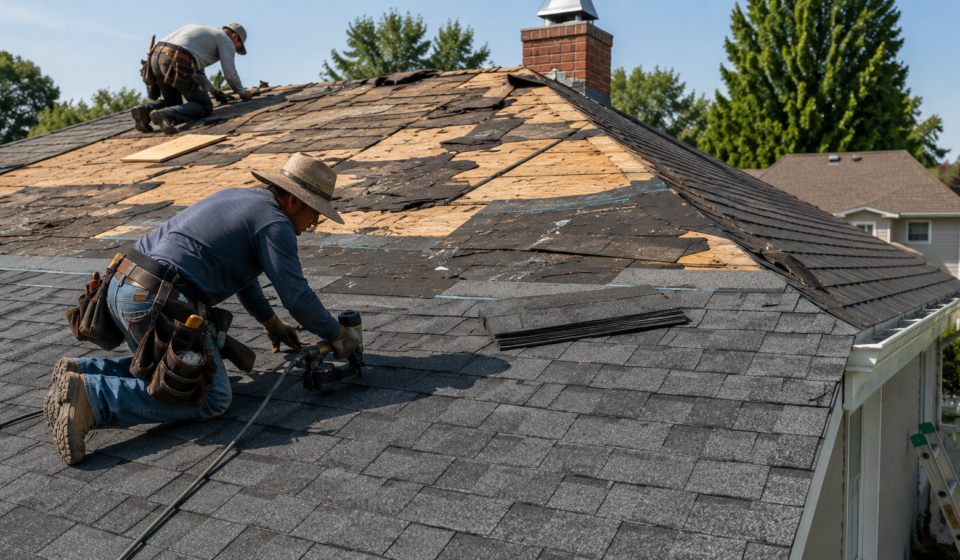
Tear-off: In most jurisdictions, you can install new roofing over one existing layer (re-roofing or overlay), but two or more layers must be torn off before adding new material. Tear-off costs $1 to $5 per square foot depending on labor and disposal rates in your area. On a 25-square roof, full tear-off adds $2,500 to $12,500. Some jurisdictions require tear-off regardless of existing layer count.
Decking: Once the old roofing is removed, roofers inspect the plywood or OSB decking underneath. Rotted, warped, or soft decking must be replaced before new roofing goes on. Decking replacement costs $2 to $4 per square foot. On a 2,000 square foot home, replacing 25% of the decking adds $1,000 to $2,000. In an older home with significant moisture history, far more decking may need replacement.
These are the two most common sources of roof replacement budget overruns. Building a 10% to 15% contingency into your budget accounts for the decking and miscellaneous fascia, flashing, or ventilation work that tear-off reveals. Our guide to hidden costs of hiring a contractor covers this dynamic in depth.
What Drives Roof Replacement Cost
Roof size and pitch: These are the primary cost drivers. More squares means more material and labor. A steeper pitch adds a labor premium and safety equipment costs.
Material: As shown in the table above, material choice drives a 3x to 10x range in per-square cost from basic asphalt to slate.
Number of layers: If tear-off is required, it adds $1 to $5 per square foot. Multiple layers of old roofing mean more weight to remove and dispose of.
Complexity: A simple gable roof with no valleys, dormers, or penetrations is the cheapest to reroof. A complex hip roof with multiple valleys, chimneys, skylights, and vent pipes requires more flashing, more cuts, and more labor per square.
Location and season: Regional labor rates affect roofing costs as they do every trade. See our guide on renovation cost by region for geographic benchmarks. Scheduling in fall or late winter, when demand is lower, can sometimes produce 5% to 10% savings.
Flashing and accessories: Step flashing around chimneys and walls, valley flashing, ice and water shield in cold climates, and ridge ventilation all add material cost that entry-level estimates may omit.
Signs You Need a Replacement vs Repair
Choosing between a repair and a full replacement is a meaningful financial decision. Here are the key indicators:
Repair ($500 to $3,000): Isolated shingle damage from storm damage, a small leak around a vent pipe, or cracked flashing around a chimney are all repair territory. If the roof is under 15 years old and the issue is isolated, repair is almost always the right call.
Replacement ($9,000 to $22,000+): A roof over 20 to 25 years old showing widespread granule loss, sagging or wavy decking, daylight visible in the attic, or multiple simultaneous leak points has reached end of life. At this stage, repeated repairs cost more than a replacement over the next few years.
The dividing line is often the roof’s age relative to its expected lifespan. A 20-year-old 3-tab shingle roof repaired for $1,500 will likely need another repair in two years, and another two years after that. A full replacement at $12,000 eliminates that cycle for 25 to 30 years.
How to Budget and Get Bids
Start with a rough estimate based on your home’s footprint, roof pitch, and material choice using the tables above. This gives you a feasibility number before you invest time in getting formal bids.
Then get three bids from licensed roofing contractors, not just one. Roofing bids vary more than most homeowners expect, and comparing three gives you the information to identify outliers. The hidden costs of hiring a contractor guide explains how to read what each bid covers. When comparing bids, make sure each one specifies the material brand and product line, the number of layers to be torn off, the decking replacement price per sheet, and the warranty terms on both the material and the installation.
Budget a 10% to 15% contingency for decking damage and flashing replacements. Pay attention to the warranty: most manufacturers offer 25- to 50-year material warranties, but the installation warranty from the contractor matters just as much. A contractor who backs their installation for 5 to 10 years is a better choice than one offering only the manufacturer warranty. Tie payment to completion of the full job, not to material delivery.
Frequently Asked Questions
How much does a roof replacement cost?
Most roof replacements cost $9,000 to $22,000 in 2026, with a national average around $14,500 for a standard home with architectural asphalt shingles. Metal roofing runs $16,000 to $40,000 or more for the same home. Cost depends on home size, roof pitch, material, whether tear-off is needed, and local labor rates.
How is roofing priced?
Roofing is priced by the roofing square, where one square equals 100 square feet of roof surface. Material rates run $400 to $900 per square for architectural asphalt and $800 to $2,000 or more for metal. A 2,000 square foot home typically has 25 to 30 roofing squares depending on pitch. Labor adds $1 to $5 per square foot for the installation.
How long does a new roof last?
Architectural asphalt shingles last 25 to 30 years. Metal roofing lasts 40 to 70 years. Clay and concrete tile lasts 40 to 50 years or more. Slate lasts 75 to 150 years. Roof lifespan depends on the material, installation quality, climate, and maintenance.
Is it worth getting a metal roof?
Metal roofing costs 2 to 4 times more than asphalt upfront but lasts two to three times longer. For a homeowner planning to stay 20 to 30 years, the total cost can be lower than replacing asphalt twice over the same period. Metal also adds more resale value and is more energy efficient in hot climates. It is worth the premium for long-term owners.
How do I know when my roof needs to be replaced?
Signs a roof needs replacement include granule loss on shingles (gutters filling with granules), sagging or wavy decking, multiple simultaneous leaks, daylight visible in the attic, and age over 20 to 25 years for asphalt. If isolated repairs are needed more than once in two years, full replacement is usually the better financial choice.
Do I need a permit for a roof replacement?
Most jurisdictions require a permit for a full roof replacement. Permit fees, covering the scope of work for the full replacement, typically run $150 to $500. Always confirm permits are required and have your contractor pull them. Some areas require a building inspection of the decking before new material is applied. Your roofing contractor should pull the permit, not ask you to do it. Always verify permit requirements with your local building department.
Final Word
Roof replacement costs $9,000 to $22,000 for most homes in 2026, with a national average around $14,500 for architectural asphalt shingles. Roof size, pitch, material, and the number of layers requiring tear-off are the primary cost drivers. Metal roofing costs more upfront but delivers a lifespan of 40 to 70 years, potentially making it the lower total-cost option for long-term homeowners.Get three detailed bids specifying material brand, tear-off scope, decking replacement price, and warranty terms. Budget a 10% to 15% contingency for the decking damage and flashing work that tear-off commonly reveals.
Pay attention to installation warranties alongside manufacturer warranties, and tie payment to project completion. A well-installed roof protects everything in the home, making it one of the most important maintenance investments you will make. If you are planning additional projects alongside a roof, see our guide on home addition cost for the structural side, and our pillar on how much a home renovation costs for the whole-home picture and how much does a home renovation cost at every level of scope. For the full cost picture, see our guides on whole house renovation cost, renovation cost by region, and the pillar on how much a home renovation costs.